Posts

Showing posts with the label Science

Accepting Abstracts: IMCC8 Deep Sea Mining Symposium

Image
Center for American Progress organized a symposium on "Beyond 30x30" at IMCC7 in Cape Town, South Africa in 2024 Abstract submissions are now open for the 8th International Marine Conservation Congress (IMCC8 ), taking place November 13–17, 2026, in Edinburgh, Scotland—and we’re excited to announce an open symposium on deep‑sea mining. Titled “Between a Rock and a Deep Place: Science and Deep Sea Mining Policy,” this session will examine the science, ethics, and governance shaping one of the most consequential ocean debates of our time. Speakers will explore emerging research on deep‑sea ecosystems, environmental risks, and scientific uncertainty, alongside equity, Indigenous rights , and global policy dynamics, including ongoing International Seabed Authority negotiations. Researchers and practitioners interested in contributing are encouraged to submit abstracts by May 15, 2026. When submitting, select Open Symposia and choose the symposium title. Summary of topics to...

Understanding and Using the MPA Guide

Image
I took a social media class one time where the instructor said people are more likely to share your tweets if it includes a quote and a picture. I’ve worked since 2008 to designate some of the largest marine protected areas (MPAs) in the United States and around the world.  Since my first day on the job, the global growth of marine protected areas has been exponential, expanding from less than one percent of the ocean when I started and slowly inching towards ten percent today.  But not all marine protected areas are created the same. In my career I’ve advocated for some of the largest, most highly protected marine sanctuaries on the planet, including the Mariana Trench and the Pacific Remote Islands Marine National Monuments in the US Pacific Territories.  But some protected areas are poorly designed and allow all sorts of damaging activities, from industrial fishing to deep sea mining, while others are poorly implemented, the oft-maligned "paper parks" that have stro...

Johnson and Villagomez: More Work Needed on MPAs

Image
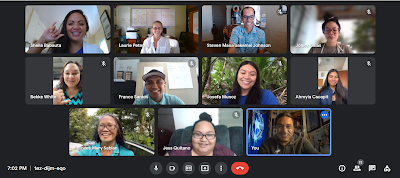
Some of the Indigenous scientists from Saipan and Guam on a zoom call to discuss MPAs and OECMs in the Mariana Islands Dr. Steven Mana‘oakamai Johnson and I published a peer reviewed paper this summer, "Assessing the quantity and quality of marine protected areas in the Mariana Islands."  We later published this op-ed in the Pacific Daily News to communicate our findings to the communities back home.  This was the first paper I've done with Dr.  Mana‘oakamai Johnson.  We're both from Saipan, and Steve's grandfather Herb Soll gave my late father, Ramon Garrido Villagomez, his first job working for the Public Defender's office in Saipan.  Our families have worked together for three generations now, and I think that is pretty cool. The waters surrounding the Mariana Islands have some of the highest levels of biodiversity in the United States. We are surrounded by migrating whales and turtles, coral reefs and hundreds of species of fish, some found nowhere el...

Connecting Conservation and Culture in Oceania

Image
I published this essay on The Saipan Blog in 2018 when President Donald J. Trump was considering downsizing, eliminating, or opening monuments to fishing, mining, and grazing.  It's a bit out of date for the issues we face in 2022, but I touch on issues of colonization and some of the cultural connections between Micronesians and Polynesians, and how geography plays a role. The Pacific Remote Islands Marine National Monument promotes biological and cultural connectivity between Micronesia and Polynesia The Pacific Remote Islands Marine National Monument is a marine protected area comprised of five large expanses of ocean surrounding seven mostly uninhabited American territories in the Pacific. The combined area, which is nearly twice the size of Texas, spans over 1.3 million sq km (490,000 sq mi) and prohibits all commercial fishing and deep sea mining, while allowing for sustainable recreational and noncommercial fishing. Wake Atoll, Johnston Atoll, Kingman Reef, Palmyr...

130 Scientists From Around the World Support Mariana Trench Sanctuary

Image
Ancient drawings on caves on Rota show the ancient link between the Chamorro people and the ocean. This letter was submitted during the public comment period for the five year review of the proposed national marine sanctuary in the Mariana Islands.  Scientists from around the world commented to bring attention to the scientific merit for the accepting the nomination. Kristina Kekuewa Pacific Islands Regional Director NOAA Office of National Marine Sanctuaries 1845 Wasp Blvd. Honolulu, Hawaii 96818 Dear Regional Director Kekuewa, We are scientists who write to you in support of accepting the nomination of the proposed national marine sanctuary in the Northern Mariana Islands.   We were invited to sign this letter by Indigenous scientists from the Mariana Islands.   The nomination package that was submitted by the Friends of the Mariana Trench builds a strong case that this region of the United States meets or exceeds the 11 sanctuary nomination process criteria used in...

Our National Monuments: Pacific Remote Islands

Image
This essay was published within the pages of  Our National Monuments , a new book by celebrated photographer QT Luong .  I co-wrote this with Gina McGuire, a Native Hawaiian scientist who serves on the community group for the Pacific Remote Islands Marine National Monument with me.  Our audience for this essay is all Americans, especially those who will never visit these islands and who have probably never even heard of them, and we aim to tell them why we think these islands play an important role in the American story. We are Native Hawaiians and Chamorros, born and raised on different islands with unique people.   We are connected by our values, the Pacific Ocean, and our shared commitment to protecting and understanding our oceanic resources and cultures so we can pass them down to future generations.   As stewards of Moana (the ocean), we humbly ask to share our understanding of how the significant history and natural resources of our remote Pacific Islands...